Dengue vs Malaria: How to Tell the Difference
Fever during the monsoon season is a common reason for visiting a doctor in Pakistan. Two of the most important mosquito-borne illnesses—dengue fever and malaria—can begin with similar symptoms, making it difficult to tell them apart without proper medical evaluation.
Both diseases can cause high fever, body aches, headache, and weakness. However, they are caused by different organisms, spread by different mosquitoes, and require different approaches to diagnosis and treatment.
Recognizing the differences is important because malaria requires prompt treatment with antimalarial medicines, while dengue is managed with supportive care, hydration, and careful monitoring. Delaying the correct diagnosis may increase the risk of serious complications.
This guide explains how dengue and malaria differ, the symptoms they share, how doctors diagnose them, and when you should seek urgent medical attention.
Quick Answer
Although dengue and malaria may both cause fever, they are different diseases.
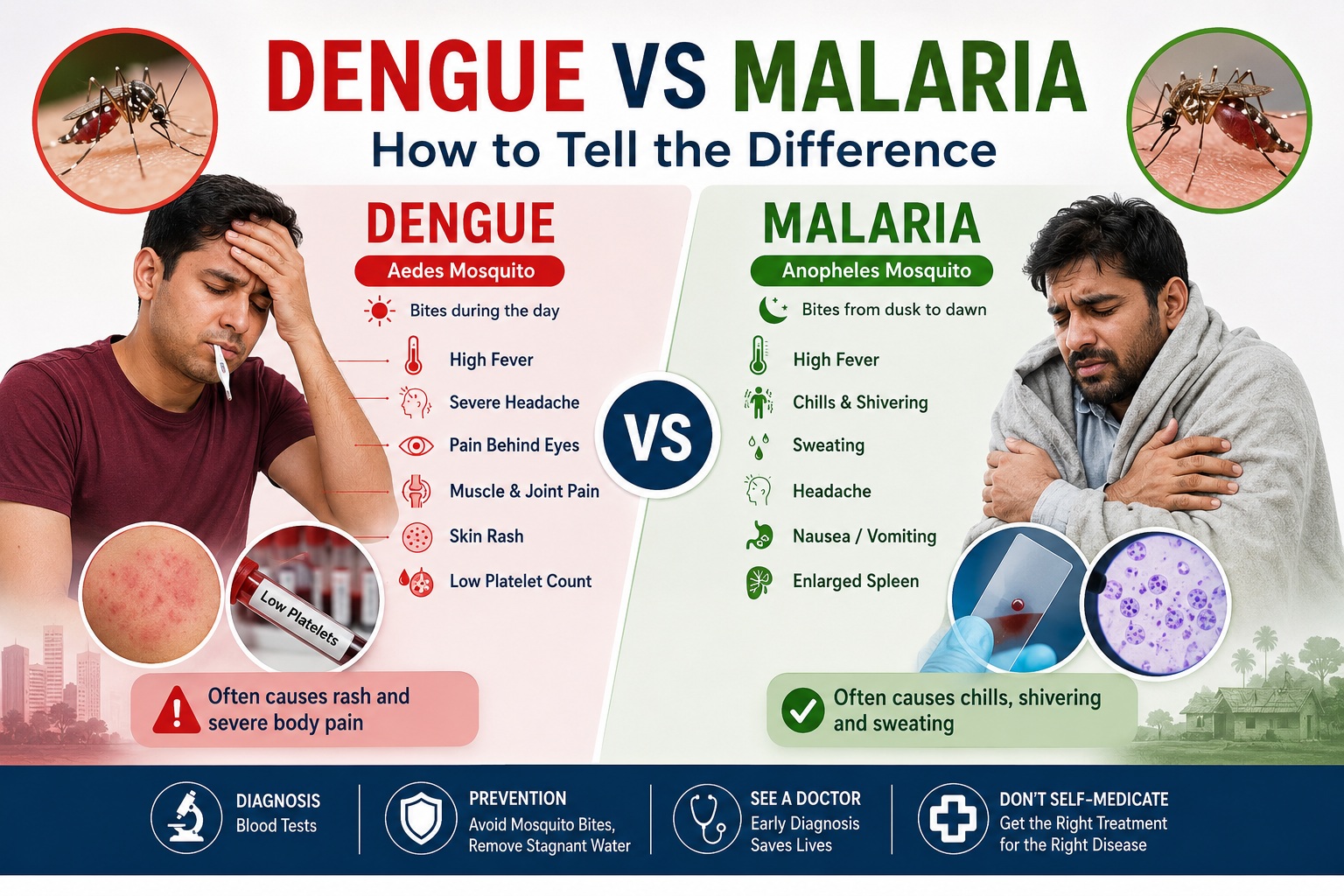
- Dengue is caused by the dengue virus and is spread by infected Aedes mosquitoes, which usually bite during the daytime.
- Malaria is caused by Plasmodium parasites and is spread by infected Anopheles mosquitoes, which usually bite between dusk and dawn.
Dengue often causes severe muscle and joint pain, a skin rash, and a low platelet count. Malaria more commonly causes chills, shaking, sweating, and fever that may occur in cycles. Because symptoms can overlap, laboratory testing is usually needed to confirm the diagnosis.
What Is Dengue?
Dengue is a viral infection caused by one of four closely related dengue virus serotypes (DENV-1, DENV-2, DENV-3, and DENV-4). It is transmitted through the bite of an infected Aedes aegypti or Aedes albopictus mosquito.
In Pakistan, dengue cases typically increase during and after the monsoon season, when standing water provides ideal breeding sites for mosquitoes.
Most people recover within one to two weeks, but some develop severe dengue, which can lead to bleeding, plasma leakage, organ impairment, and shock if not treated promptly.
Common symptoms include:
- Sudden high fever
- Severe headache
- Pain behind the eyes
- Muscle and joint pain
- Fatigue
- Nausea and vomiting
- Skin rash
- Mild bleeding, such as nosebleeds or bleeding gums
What Is Malaria?
Malaria is a parasitic disease caused by Plasmodium parasites. Humans become infected after being bitten by an infected female Anopheles mosquito.
Several species of Plasmodium infect humans, but the most important are:
- Plasmodium falciparum (can cause severe malaria)
- Plasmodium vivax (commonly reported in Pakistan)
- Plasmodium malariae
- Plasmodium ovale
- Plasmodium knowlesi (primarily found in parts of Southeast Asia)
Malaria remains a significant public health concern in many parts of Pakistan, particularly in areas with suitable mosquito breeding conditions.
Common symptoms include:
- Fever
- Chills
- Shivering
- Sweating
- Headache
- Muscle aches
- Fatigue
- Nausea or vomiting
Without timely treatment, malaria—especially P. falciparum malaria—can become life-threatening.
Dengue vs Malaria: At a Glance
| Feature | Dengue | Malaria |
|---|---|---|
| Cause | Dengue virus | Plasmodium parasite |
| Spread by | Aedes mosquito | Anopheles mosquito |
| Mosquito biting time | Mainly during the day | Mainly from dusk to dawn |
| Human-to-human spread | No (except rare situations such as blood transfusion or from mother to baby) | No (except rare situations such as blood transfusion or from mother to baby) |
| Main treatment | Supportive care | Antimalarial medicines |
| Vaccine availability | Limited use in specific settings; not part of routine prevention for the general population in Pakistan | Malaria vaccines exist for specific settings, mainly for children in some high-transmission African countries; they are not part of routine malaria prevention in Pakistan |
How Do Dengue and Malaria Spread?
Although both illnesses are transmitted by mosquitoes, they involve different mosquito species with different biting habits.
Dengue
Dengue spreads through infected Aedes mosquitoes.
These mosquitoes:
- Prefer urban and semi-urban environments.
- Breed in clean, stagnant water found in containers such as buckets, flower pots, tyres, rooftop tanks, and coolers.
- Are most active during the early morning and late afternoon, although they may bite during other daylight hours.
Because they bite during the day, protection against dengue requires more than just sleeping under a mosquito net.
Malaria
Malaria spreads through infected Anopheles mosquitoes.
These mosquitoes:
- Are most active from sunset to sunrise.
- Breed in a variety of water bodies, depending on the species and local environment.
- Commonly bite while people are sleeping.
Sleeping under insecticide-treated mosquito nets and reducing mosquito exposure at night are important measures to help prevent malaria.
Dengue vs Malaria Symptoms: What Are the Differences?
Both dengue and malaria often begin with a fever, headache, body aches, and general weakness. Because these early symptoms overlap, it is usually not possible to diagnose either disease based on symptoms alone. Laboratory tests are often needed to confirm the cause.
However, certain features may make one illness more likely than the other.
Symptom Comparison
| Symptom | Dengue | Malaria |
|---|---|---|
| High fever | ✓ Common | ✓ Common |
| Severe headache | ✓ Common | ✓ Common |
| Chills and shivering | Less common | ✓ Very common |
| Sweating after fever | Uncommon | ✓ Common |
| Muscle and joint pain | ✓ Very common | Common |
| Pain behind the eyes | ✓ Characteristic symptom | Rare |
| Skin rash | ✓ Common | Rare |
| Nausea and vomiting | ✓ Can occur | ✓ Can occur |
| Fatigue and weakness | ✓ Common | ✓ Common |
| Low platelet count | ✓ Common | Can occur but usually less marked |
| Enlarged spleen | Rare | More common |
Remember that every patient is different. Some people may not develop all of these symptoms.
How Does the Fever Differ?
The pattern of fever can provide clues, but it cannot confirm the diagnosis.
Dengue Fever
Dengue usually causes:
- Sudden onset of high fever
- Temperature often reaching 39–40°C
- Fever lasting 2 to 7 days
- Continuous or persistent fever rather than predictable cycles
Many patients describe feeling as though they were “hit by a truck” because of the severe muscle and joint pain.
Malaria Fever
Malaria often causes fever episodes that may include:
- Intense chills
- Shivering or rigors
- High fever
- Heavy sweating as the fever settles
Depending on the Plasmodium species, fever may occur in cycles, although this classic pattern is not always present, especially early in the illness.
Rash vs Chills: One of the Biggest Differences
One of the easiest ways to remember the difference is:
Dengue often causes a rash.
The rash may:
- Appear several days after the fever begins.
- Look like small red spots or widespread redness.
- Be itchy in some patients.
- Vary in appearance from person to person.
Not every patient develops a rash, but it is a well-recognised feature of dengue.
Malaria usually causes chills.
Patients frequently report:
- Feeling extremely cold despite having a high fever.
- Violent shivering.
- Sweating heavily once the fever breaks.
A skin rash is uncommon in uncomplicated malaria.
Why Does Dengue Cause Low Platelets?
A falling platelet count is one of the features doctors monitor closely in dengue.
The dengue virus can temporarily affect the bone marrow and increase platelet destruction, leading to thrombocytopenia (a low platelet count).
However, platelet count alone does not determine how severe dengue is. Doctors also assess:
- Bleeding
- Blood pressure
- Hydration status
- Warning signs
- Laboratory results such as haematocrit
This is why some patients with low platelet counts may be safely managed without a platelet transfusion, while others require hospital care.
Does Malaria Also Reduce Platelets?
Yes, it can.
Although low platelet counts are strongly associated with dengue, malaria can also cause thrombocytopenia.
However:
- The decrease is often less pronounced than in dengue.
- Doctors use the overall clinical picture and laboratory tests, not platelet count alone, to distinguish between the two diseases.
This is one reason why self-diagnosis based on a CBC report is not reliable.
Can You Have Dengue and Malaria at the Same Time?
Yes.
Although uncommon, co-infection with dengue and malaria has been reported in countries where both diseases occur, including parts of South Asia.
Patients with both infections may have overlapping symptoms, making diagnosis more challenging.
Doctors may request tests for both diseases if:
- The clinical picture is unclear.
- The patient lives in or has recently travelled to an area where both infections are common.
- Initial test results do not fully explain the illness.
Prompt diagnosis is important because malaria requires specific antimalarial treatment, while dengue is managed with supportive care.
Which Disease Is More Dangerous?
Both dengue and malaria can become serious if not diagnosed and treated appropriately.
Severe Dengue
Complications may include:
- Severe bleeding
- Plasma leakage
- Shock
- Organ impairment
The risk of severe dengue is highest during the critical phase, which often begins as the fever starts to improve.
Severe Malaria
Malaria caused by Plasmodium falciparum can lead to:
- Severe anaemia
- Kidney failure
- Breathing problems
- Seizures
- Cerebral malaria (brain involvement)
- Multi-organ failure
Without prompt treatment, severe malaria can be life-threatening.
The important point is not which disease is “worse,” but recognising symptoms early and receiving the correct diagnosis and treatment without delay.
How Are Dengue and Malaria Diagnosed?
Because the symptoms of dengue and malaria can overlap, laboratory testing is usually needed to confirm the diagnosis. Doctors consider your symptoms, physical examination, travel history, local disease activity, and blood test results before deciding on the most likely cause of illness.
Tests Used to Diagnose Dengue
Depending on how many days you have been ill, your doctor may recommend one or more of the following tests:
- NS1 Antigen Test: Most useful during the first few days of illness, when the virus is circulating in the blood.
- Dengue IgM and IgG Antibody Tests: These help identify a recent or past dengue infection and are usually more useful after the first few days of symptoms.
- PCR (Polymerase Chain Reaction): Available in some laboratories, this test detects the genetic material of the dengue virus and is mainly used in specialised settings.
- Complete Blood Count (CBC): Although a CBC cannot diagnose dengue, it helps monitor platelet count, white blood cell count, and haematocrit, which are important in assessing the patient’s condition.
Tests Used to Diagnose Malaria
To diagnose malaria, doctors typically use:
- Peripheral Blood Smear: A microscope is used to look for malaria parasites in a blood sample. This remains the gold standard in many healthcare settings.
- Rapid Diagnostic Test (RDT): These tests detect malaria antigens and provide results quickly. They are widely used where microscopy may not be immediately available.
- Additional Blood Tests: Depending on the patient’s condition, doctors may also request a CBC and tests to assess kidney and liver function.
Your doctor may order tests for both dengue and malaria if your symptoms are not typical or if both diseases are circulating in your area.
Dengue vs Malaria: Diagnosis Comparison
| Feature | Dengue | Malaria |
|---|---|---|
| Main diagnostic tests | NS1 antigen, IgM/IgG, PCR | Peripheral blood smear, Rapid Diagnostic Test (RDT) |
| CBC helpful? | Yes, for monitoring platelets and haematocrit | Yes, but not sufficient to confirm malaria |
| Can diagnosis be based on symptoms alone? | No | No |
Treatment: Why the Correct Diagnosis Matters
Although dengue and malaria may look similar in the early stages, their treatment is very different.
Treatment for Dengue
There is no specific antiviral medicine that cures dengue.
Treatment focuses on:
- Adequate hydration
- Rest
- Monitoring for warning signs
- Paracetamol for fever and pain, when appropriate
- Regular follow-up and blood tests if advised by a doctor
Medicines such as ibuprofen, diclofenac, aspirin, and naproxen are generally avoided unless specifically prescribed by a healthcare professional, as they may increase the risk of bleeding in patients with dengue.
Most people with mild dengue recover with supportive care, but some require hospital admission for intravenous fluids and close monitoring.
Treatment for Malaria
Unlike dengue, malaria is treated with specific antimalarial medicines.
The choice of medicine depends on several factors, including:
- The Plasmodium species causing the infection
- Whether the malaria is uncomplicated or severe
- Local treatment guidelines
- The patient’s age, pregnancy status, and overall health
Because delayed treatment can lead to serious complications, anyone diagnosed with malaria should begin appropriate treatment as soon as possible under medical supervision.
Can You Prevent Dengue and Malaria the Same Way?
Many prevention measures overlap because both diseases are spread by mosquitoes.
These include:
- Removing standing water around homes
- Using mosquito repellents
- Wearing long-sleeved clothing when practical
- Installing window and door screens
- Sleeping under insecticide-treated mosquito nets, particularly to reduce the risk of malaria
- Following local public health advice during outbreaks
Understanding the mosquitoes’ biting habits is also important:
- Aedes mosquitoes (dengue) mainly bite during the daytime, especially in the early morning and late afternoon.
- Anopheles mosquitoes (malaria) usually bite between dusk and dawn.
Protecting yourself throughout the day and night provides the best defence in areas where both diseases occur.
Frequently Asked Questions
Can I tell the difference between dengue and malaria at home?
No. While certain symptoms may suggest one disease over the other, only appropriate medical evaluation and laboratory tests can confirm the diagnosis.
Which disease causes lower platelets?
Dengue is more commonly associated with a significant drop in platelet count. However, malaria can also cause thrombocytopenia, so platelet count alone cannot distinguish between the two.
Does every fever during the monsoon mean dengue or malaria?
No. Fever can be caused by many infections, including influenza, COVID-19, typhoid, urinary tract infections, and other viral illnesses. A doctor can help determine the underlying cause.
Can children develop both dengue and malaria?
Yes. Children can develop either disease, and in rare cases, they may have both infections simultaneously. Any child with a persistent high fever should be assessed promptly by a healthcare professional.
Key Takeaways
- Dengue and malaria are different mosquito-borne diseases caused by different organisms.
- Dengue is caused by a virus, while malaria is caused by Plasmodium parasites.
- Dengue commonly causes severe body aches, pain behind the eyes, rash, and a significant drop in platelet count.
- Malaria often presents with chills, shivering, sweating, and requires prompt treatment with antimalarial medicines.
- Symptoms alone are not enough to distinguish between the two diseases. Laboratory testing is usually required.
- Early diagnosis and appropriate treatment are essential to reduce the risk of complications.
When to See a Doctor
If you develop a high fever, severe headache, chills, body aches, rash, persistent vomiting, unusual bleeding, difficulty breathing, confusion, or extreme weakness, seek medical attention promptly. Early diagnosis is especially important in Pakistan during the monsoon season, when dengue and malaria cases may increase.
Seek emergency medical care immediately if you experience warning signs such as severe abdominal pain, persistent vomiting, bleeding from the nose or gums, blood in vomit or stool, difficulty breathing, reduced consciousness, seizures, or signs of dehydration.
Do not rely on home remedies or self-medication to distinguish or treat dengue and malaria. Prompt medical assessment and the appropriate laboratory tests are the safest way to identify the cause of fever and begin the correct treatment.