EECP Therapy for Angina: Can It Reduce Chest Pain?
Yes, EECP therapy can reduce chest pain in some people with chronic angina, particularly patients with persistent or refractory angina despite appropriate medical treatment. Studies have reported fewer angina episodes, improved exercise tolerance and better quality of life after treatment. However, EECP is not a treatment for a heart attack or unstable angina, and it is not a universal replacement for angioplasty, stents or bypass surgery.
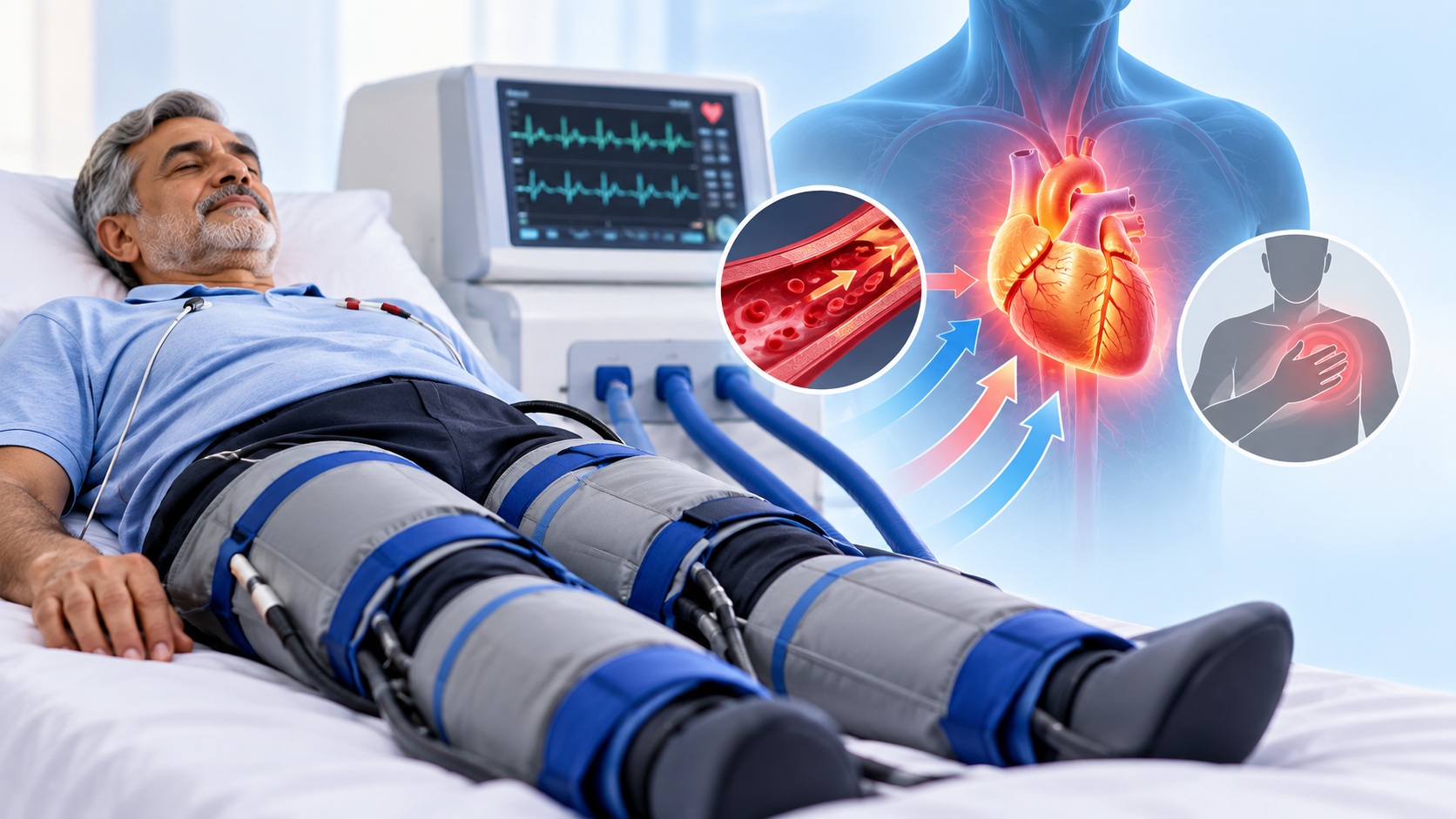
Enhanced External Counterpulsation (EECP) is a non-invasive treatment that uses inflatable cuffs around the legs to alter blood flow in synchronization with the heartbeat. A standard treatment course commonly consists of 35 one-hour sessions, often delivered five days per week for seven weeks.
For appropriately selected patients who continue to experience angina despite conventional treatment—or who are not suitable candidates for further coronary intervention—EECP may provide another way of controlling symptoms.
What Is Angina?
Angina is chest pain or discomfort caused when part of the heart muscle is not receiving enough oxygen-rich blood for its needs.
It is commonly associated with coronary artery disease (CAD), where coronary arteries supplying the heart become narrowed by atherosclerosis.
Stable angina often occurs predictably during situations that make the heart work harder, such as:
- Walking quickly
- Climbing stairs
- Physical exercise
- Emotional stress
- Cold weather
- Heavy meals in some patients
The discomfort may feel like pressure, squeezing, tightness, heaviness or burning rather than a sharp pain.
Some people experience discomfort spreading to the arm, shoulder, neck, jaw or back. Shortness of breath and fatigue may accompany the chest discomfort.
What Is Refractory Angina?
Most people with chronic angina can be managed using lifestyle measures, medicines and, where appropriate, procedures that restore coronary blood flow.
Medicines may include anti-anginal drugs and therapies that reduce cardiovascular risk. Some patients undergo percutaneous coronary intervention (PCI), such as angioplasty and stenting, or coronary artery bypass grafting (CABG).
However, a smaller group continues to experience troublesome angina despite appropriate treatment. This is often referred to as refractory angina.
Some of these patients have already undergone stenting or bypass surgery but continue to experience symptoms. Others have coronary disease that cannot easily be treated with another revascularization procedure.
This is one of the clinical situations in which EECP may be considered.
How Does EECP Work?
EECP is performed while the patient lies on a treatment bed.
Large inflatable cuffs are wrapped around the:
- Calves
- Lower thighs
- Upper thighs/buttock region
The patient is connected to an electrocardiogram (ECG), allowing the EECP machine to coordinate cuff inflation and deflation with each heartbeat.
The cuffs inflate sequentially during diastole, when the heart relaxes and receives much of its coronary blood supply. They then rapidly deflate immediately before the heart contracts.
This produces two important immediate hemodynamic effects: it can increase diastolic blood flow toward the heart and reduce the resistance against which the heart pumps during systole.
How Could EECP Reduce Angina?
EECP’s effects are more complicated than simply “pushing more blood into the heart.”
Researchers have proposed several mechanisms that may contribute to symptom improvement.
Improved Coronary Perfusion
Inflation of the leg cuffs during diastole increases pressure in the arterial system during the phase when coronary blood flow occurs.
This may improve delivery of blood to areas of heart muscle affected by inadequate circulation.
Reduced Workload on the Heart
Rapid cuff deflation before the heart contracts can reduce afterload—the resistance the left ventricle must overcome when pumping blood.
Reducing cardiac workload may help improve the balance between the heart’s oxygen supply and demand.
Effects on Blood-Vessel Function
Repeated changes in blood flow during a full EECP course may affect the inner lining of blood vessels, known as the endothelium.
Research has reported improvements in vascular function and arterial properties following EECP treatment.
Collateral Circulation
EECP is sometimes described as helping the body develop a “natural bypass.”
That description should be used cautiously.
Repeated increases in blood flow and vascular shear stress may support changes in collateral circulation and vascular function, but EECP does not mechanically open a blocked coronary artery in the way angioplasty and stenting can.
It also does not create a surgical bypass around an obstruction.
Does EECP Actually Reduce Chest Pain?
The evidence suggests that many appropriately selected patients with refractory angina experience symptomatic improvement, although the quality and strength of the evidence vary between studies.
One of the key randomized trials was the Multicenter Study of Enhanced External Counterpulsation (MUST-EECP) involving 139 patients with angina and documented coronary artery disease.
Active EECP significantly increased the time before exercise-induced ischemic ECG changes occurred compared with inactive counterpulsation. More patients receiving active EECP also experienced reductions rather than increases in angina episodes. However, the difference in total exercise duration was not statistically significant, and the between-group difference in nitroglycerin use was also not significant.
This nuance is important: EECP has promising evidence for symptom improvement, but it should not be marketed as a guaranteed treatment for angina.
What Do Larger Patient Studies Show?
The International EECP Patient Registry provides useful information about outcomes in real-world patients with difficult-to-treat angina.
A long-term analysis included 1,427 patients, many of whom had extensive coronary disease and previous revascularization. Before treatment, 89% had severe Canadian Cardiovascular Society (CCS) class III or IV angina.
After EECP:
78% improved by at least one CCS angina class, while 38% improved by at least two classes.
The investigators reported that much of the symptomatic benefit was maintained during longer-term follow-up.
Registry studies are valuable but cannot establish treatment effectiveness as reliably as well-designed randomized controlled trials because they do not provide the same level of comparison against placebo or alternative treatment.
What Does More Recent Evidence Show?
A recent systematic review and meta-analysis evaluated 26 studies involving patients with chronic refractory angina.
EECP was associated with improvements in:
- Angina severity
- Nitroglycerin use
- Six-minute walking performance
- Treadmill exercise performance
- Quality of life
However, the researchers also emphasized substantial differences between studies and noted that some of the largest reported benefits came from uncontrolled before-and-after studies.
They concluded that EECP appears to be a reasonable adjunctive treatment for appropriately selected patients who remain symptomatic despite conventional therapy, while additional high-quality controlled research remains desirable.
That is a more balanced interpretation than claiming EECP “cures” angina.
How Much Can Chest Pain Improve?
There is no way to predict exactly how much an individual patient’s angina will improve.
Some patients experience a meaningful reduction in:
- Frequency of chest pain
- Severity of angina
- Need for short-acting nitrate medication
- Limitations during physical activity
Others may experience relatively little improvement.
An older meta-analysis of 18 studies reported that approximately 85% of treated patients improved by at least one CCS angina class, although the authors also noted that further research was needed to establish long-term benefits.
These percentages should therefore be understood as study findings—not a promise that a particular patient has an 85% chance of success.
Can EECP Help You Walk Further Without Chest Pain?
For some patients, yes.
One objective of EECP is to allow people with chronic angina to perform more activity before ischemic symptoms limit them.
Studies have reported improvements in exercise-related measurements and walking ability after EECP. The recent meta-analysis found improvements in both six-minute walking distance and treadmill exercise measures.
This can be particularly meaningful for someone whose angina interferes with routine activities such as walking outside, climbing stairs or performing household tasks.
Can EECP Reduce the Need for Nitroglycerin?
Some patients report needing less short-acting nitrate medication after successful EECP treatment.
Registry studies and pooled observational evidence have shown reductions in nitrate use, although results from controlled studies have been less consistent.
Patients should not stop or reduce prescribed heart medicines themselves, even if their chest pain improves substantially.
Medication changes should be made by the treating cardiologist.
How Long Does EECP Treatment Take?
A conventional EECP treatment course usually consists of approximately:
35 hours of treatment
A common schedule is:
1 hour per day × 5 days per week × 7 weeks
Different schedules can sometimes be used depending on the treatment centre and patient’s circumstances.
EECP is usually performed as an outpatient procedure, so hospital admission is generally not required for each session.
What Does an EECP Session Feel Like?
The patient remains awake throughout treatment.
The cuffs around the legs repeatedly tighten and release in coordination with the heartbeat. Patients can feel strong pressure moving upward along the legs.
It may feel unusual during the first few sessions, but many patients become accustomed to it.
Treatment should not normally cause significant chest pain or severe discomfort. Any concerning symptoms during a session should be reported immediately to the clinical team.
When Might Someone Notice an Improvement?
EECP is not usually a treatment where the expected benefit is judged after a single session.
Some patients notice improvement during the treatment course, while others may experience benefits later in the course or after completing it.
Cleveland Clinic notes that many patients who improve begin noticing changes during the later weeks of the typical seven-week treatment programme.
The response varies considerably between individuals.
How Long Do the Benefits Last?
Some studies suggest that symptom improvements can persist beyond completion of treatment.
In the International EECP Patient Registry study, many patients maintained improvements during approximately three years of follow-up.
Another registry analysis involving patients with refractory angina and impaired left ventricular function found that improvement in angina and quality of life persisted in a substantial proportion at two years.
Again, these are observational results. Individual duration of benefit can differ, and some patients eventually undergo another EECP course.
Who May Be Considered for EECP?
EECP is particularly associated with chronic stable or refractory angina.
A cardiologist may consider it in selected patients who:
- Continue to experience angina despite appropriate medicines
- Have persistent symptoms after previous angioplasty or stenting
- Continue to have angina after bypass surgery
- Are not suitable candidates for another revascularization procedure
- Have symptoms that significantly interfere with everyday activity
Patient selection is important. EECP should follow appropriate cardiovascular evaluation rather than being used simply because someone experiences unexplained chest pain.
Is EECP a Replacement for Angioplasty or a Heart Stent?
Not necessarily—and this is an important distinction.
EECP, PCI/stenting and bypass surgery are fundamentally different treatments.
Angioplasty can physically widen a significantly narrowed coronary artery, usually with placement of a stent. Bypass surgery creates a new route for blood to travel around severely diseased coronary arteries.
EECP does neither.
Its primary established role is symptom management in selected patients with chronic angina, particularly when symptoms persist despite conventional treatment or further revascularization is unsuitable.
A patient who has a coronary blockage requiring revascularization should not choose EECP instead of a recommended procedure without discussing the implications with a cardiologist.
Does EECP Remove Blockages From the Heart?
No.
EECP should not be described as a treatment that removes plaque, dissolves coronary blockages or cleans the arteries.
It may improve blood-flow dynamics, vascular function and symptoms, but atherosclerotic plaque remains a disease requiring appropriate cardiovascular risk management.
That may include medicines and control of:
- High cholesterol
- High blood pressure
- Diabetes
- Smoking
- Body weight
- Physical inactivity
EECP should therefore be viewed as one component of care rather than a cure for coronary artery disease.
Can EECP Prevent a Heart Attack?
EECP should not be promoted as a proven method of preventing heart attacks.
Improving angina symptoms is different from demonstrating that a treatment prevents myocardial infarction or extends life.
Medicines and interventions prescribed to reduce cardiovascular events should therefore continue unless the treating cardiologist advises otherwise.
A patient feeling substantially better after EECP should not assume that the underlying coronary disease has disappeared.
EECP Is Not an Emergency Treatment for Chest Pain
This distinction is critical.
EECP is used as a planned course of treatment for selected patients with chronic symptoms. It is not a treatment for acute coronary syndrome, unstable angina or a suspected heart attack.
New chest pain should not automatically be assumed to be the patient’s usual angina.
Seek emergency medical attention for symptoms such as:
- New or severe chest pressure or pain
- Chest pain occurring unexpectedly at rest
- Pain that is becoming more frequent or severe
- Chest discomfort accompanied by sweating, nausea or marked breathlessness
- Pain spreading to the arm, jaw, shoulder or back
- Fainting or severe weakness
- Chest pain that does not respond as expected to the patient’s prescribed emergency treatment plan
Do not delay emergency evaluation in order to attend an EECP centre.
Who May Not Be Suitable for EECP?
EECP is not appropriate for everyone.
Conditions requiring particular consideration can include certain significant heart-valve disorders, uncontrolled hypertension, some abnormal heart rhythms, severe peripheral vascular disease, blood clots and other cardiovascular or medical conditions that could make external counterpulsation unsafe or ineffective.
Pregnancy is also a contraindication.
Suitability should therefore be assessed by a cardiologist or appropriately trained cardiovascular team before treatment begins.
Side Effects of EECP
EECP is non-invasive, but that does not mean it is completely free from adverse effects.
Reported problems are generally related to the repeated pressure applied by the cuffs and can include:
- Bruising
- Skin irritation
- Blisters
- Muscle discomfort
- Joint discomfort
- Leg soreness
- Numbness or tingling
- Fatigue
- Swelling
More significant problems are uncommon but can occur, particularly when patients are not appropriately selected.
EECP and Angina With No Major Coronary Blockage
Not every person with angina has a major obstructive coronary artery blockage.
Conditions now commonly discussed as ANOCA or INOCA—angina/ischemia with no or non-obstructive coronary arteries—can involve abnormalities such as coronary microvascular dysfunction or vasospasm.
The 2024 European Society of Cardiology guidelines give increased attention to the diagnosis and management of these conditions.
Research into EECP for this population is developing.
A study of 101 patients with ANOCA and refractory angina reported improvements in angina class, weekly angina episodes, six-minute walking distance and patient-reported functional measures following EECP. However, more robust evidence is needed before these findings can be generalized to every patient with non-obstructive coronary disease.
Questions to Ask Before Starting EECP
Before beginning treatment, it is useful to discuss whether your chest pain has been adequately evaluated and whether EECP is appropriate for the specific type of angina you have.
Patients may also want to ask whether further angioplasty or bypass surgery is indicated, what improvement can realistically be expected, whether current medicines should continue, how response will be measured, what happens if symptoms worsen during the treatment course, and whether any medical conditions make EECP unsuitable.
EECP should be part of a broader cardiovascular treatment plan rather than considered in isolation.
Frequently Asked Questions
Does EECP really work for angina?
Research suggests that many appropriately selected patients with chronic refractory angina experience fewer symptoms and improved functional capacity following EECP. However, responses vary, and the evidence base includes a mixture of randomized trials and observational studies.
How many EECP sessions are needed for angina?
A conventional course consists of approximately 35 one-hour treatment sessions, commonly spread over seven weeks.
Can EECP completely stop chest pain?
Some patients experience substantial improvement, while others continue to have angina. EECP should therefore be described as a treatment that may reduce angina burden, not as a guaranteed cure.
Can I have EECP after a heart stent?
Some patients with recurrent or persistent chronic angina following previous PCI/stenting may be considered for EECP. A cardiologist should first determine why symptoms persist and whether further investigation or treatment is necessary.
Can I have EECP after bypass surgery?
Yes, selected patients who continue to have refractory angina after previous bypass surgery may be considered for EECP when clinically appropriate.
Does EECP open blocked arteries?
No. EECP does not mechanically open a coronary blockage or remove atherosclerotic plaque. Its proposed benefits involve changes in circulation, cardiac workload and vascular function.
Is EECP painful?
The cuffs produce substantial rhythmic pressure around the legs. Most appropriately selected patients tolerate treatment, although bruising, skin irritation, muscle soreness and other pressure-related effects can occur.
Should heart medicines be stopped after EECP?
No medication should be stopped simply because angina improves. Drugs prescribed for angina, cholesterol, blood pressure, diabetes, clot prevention or cardiovascular risk reduction may have benefits extending well beyond symptom control. Medication changes should be made by the treating cardiologist.
The Bottom Line
EECP can reduce chest pain and improve everyday functioning in some patients with chronic refractory angina. Its most established role is in carefully selected people who remain symptomatic despite appropriate medical therapy, including some patients who have already undergone stenting or bypass surgery or are not suitable for further revascularization.
The evidence is encouraging but should not be exaggerated. EECP does not remove coronary blockages, is not a guaranteed alternative to a stent or bypass operation, and has not been established as an emergency treatment for acute chest pain.
For someone living with persistent angina, the appropriate question is therefore not simply “Does EECP work?” but “Is my type of angina and overall heart condition suitable for EECP?”
That decision should be made after cardiovascular assessment and discussion with a cardiologist.