Dental instruments are specialized tools used by dentists and other dental professionals to examine the mouth, diagnose oral health problems, perform treatments, restore teeth, remove teeth, carry out root canal procedures, and perform oral surgery.
Some instruments, such as a dental mirror and explorer, are used during routine examinations. Others have very specific purposes, such as removing calculus, preparing a tooth for restoration, extracting a tooth, or cleaning and shaping a root canal.
For dental students and new dental professionals, the number of instruments can initially seem overwhelming. Understanding them becomes much easier when they are divided according to their function.
This guide explains the main types of dental instruments, their names, and their common uses.
Note: This guide is intended for general educational and professional reference. Dental instruments should be selected, used, cleaned, sterilized, and maintained according to professional standards, manufacturer instructions, and applicable regulations.
Types of Dental Instruments at a Glance
Dental instruments can broadly be grouped according to the procedure or function for which they are designed.
| Category | Common Examples | Primary Use |
|---|---|---|
| Examination | Mouth mirror, explorer, periodontal probe | Examining teeth and oral tissues |
| Restorative | Excavator, condenser, burnisher, carver | Restorative procedures |
| Periodontal | Scalers, curettes, periodontal probes | Periodontal examination and calculus removal |
| Extraction | Forceps, elevators, luxators | Tooth extraction |
| Endodontic | Files, reamers, spreaders, pluggers | Root canal procedures |
| Orthodontic | Pliers, cutters, bracket instruments | Orthodontic procedures |
| Surgical | Retractors, scissors, needle holders | Oral surgical procedures |
Let’s look at each category in more detail.
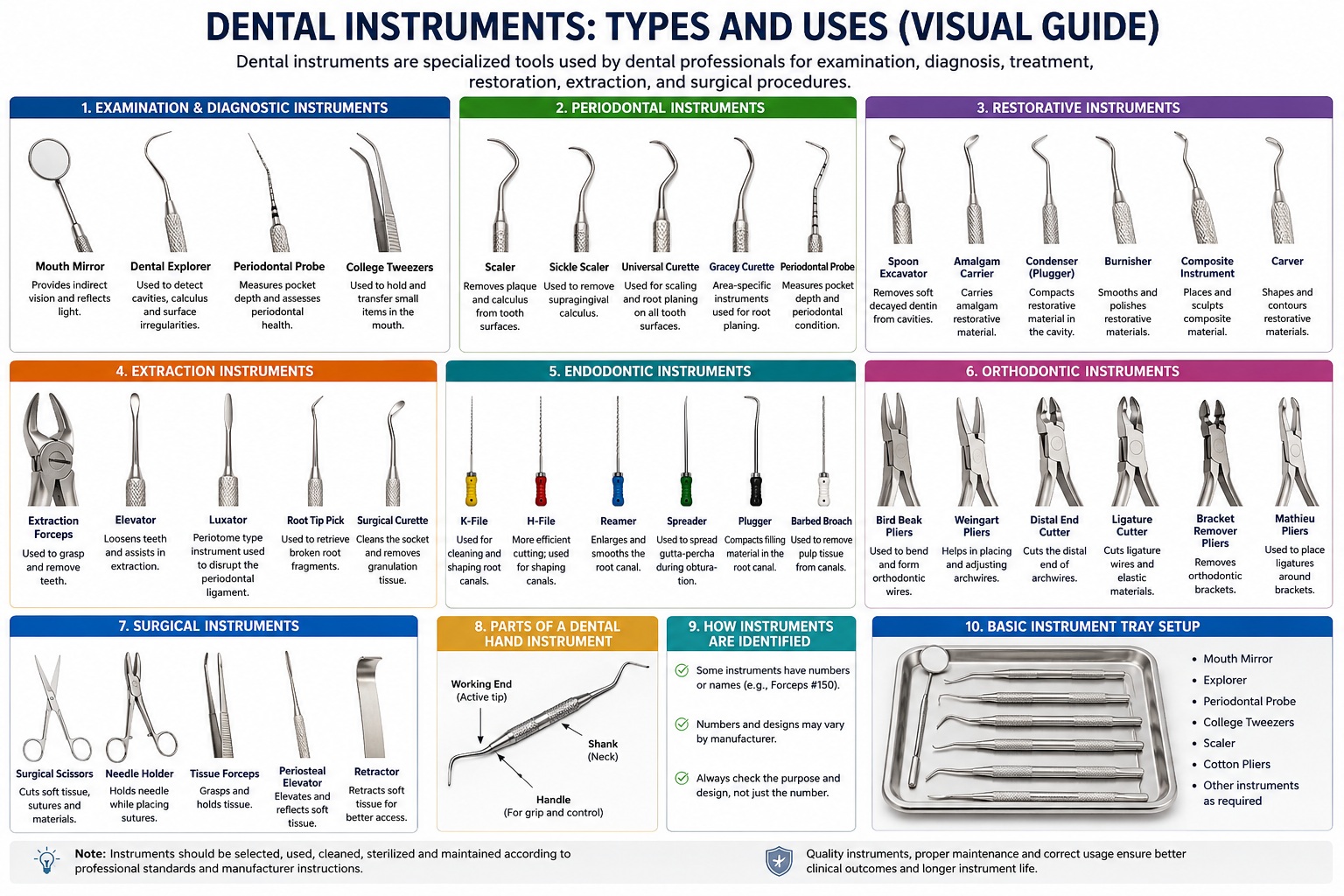
Dental Examination and Diagnostic Instruments
Examination instruments are among the most frequently used instruments in dentistry. They help the dentist inspect the teeth, gums, oral cavity, and surrounding structures.
A basic examination set commonly contains a mouth mirror, explorer or probe, periodontal probe when required, and college tweezers.
Dental Mouth Mirror
The dental mirror, also called a mouth mirror, is one of the most recognizable dental instruments.
It consists of a small mirror attached to a handle.
What is a dental mirror used for?
A mouth mirror can help a dentist:
- View areas that are difficult to see directly
- Examine posterior teeth
- Retract the cheek, tongue, or other soft tissues
- Reflect light onto areas being examined
- Improve visibility during dental procedures
Dental mirrors are available in different sizes and designs, and some systems use replaceable mirror heads.
Dental Explorer
A dental explorer is a slender hand instrument with a fine working end.
It is primarily used for tactile examination of tooth surfaces and restorations. Depending on the clinical situation and instrument design, it can help a dental professional assess surface irregularities, restoration margins, and other areas requiring closer evaluation.
Different explorer designs are available for different examination requirements.
Periodontal Probe
A periodontal probe may look similar to an explorer, but its purpose is different.
It typically has markings along its working end that allow a dental professional to take periodontal measurements.
Periodontal probes are commonly used to assess:
- Periodontal pocket depth
- Gingival condition
- Clinical attachment-related measurements
- Periodontal health over time
Different probe designs and marking systems are available.
College Tweezers
College tweezers, also known as cotton pliers, are used to grasp and transfer small objects within or outside the mouth.
They may be used to handle:
- Cotton pellets
- Small materials
- Gauze
- Other small dental items
Their angled design makes handling small objects within the oral cavity easier.
Restorative Dental Instruments
Restorative dentistry involves repairing teeth affected by decay, damage, wear, or other problems.
Different instruments may be required for preparing, placing, shaping, contouring, and finishing restorative materials.
Spoon Excavator
A spoon excavator is a hand instrument with a small spoon-shaped working end.
Depending on the procedure, it may be used for removing softened carious dentin and manipulating material within a prepared cavity.
Spoon excavators are available in different sizes and designs.
Amalgam Carrier
An amalgam carrier is designed to carry prepared amalgam restorative material to a cavity preparation.
Its role is primarily material placement rather than shaping or condensation.
Although tooth-colored restorative materials are widely used today, amalgam instruments remain relevant where amalgam restorations are performed.
Condenser or Plugger
A dental condenser, sometimes called a plugger, is used to compact restorative material into a prepared cavity.
Different working-end sizes and shapes allow the dentist to work in cavities of different dimensions.
Burnisher
Dental burnishers generally have smooth, rounded working ends.
Depending on the restorative technique and instrument design, they can be used to smooth, contour, and manipulate restorative materials.
Burnishers are available in several shapes.
Dental Carvers
Carvers are designed to shape restorative material and reproduce appropriate tooth anatomy.
Common designs vary according to the surface and restoration being shaped.
Composite Placement Instruments
Composite restorations require instruments designed to place and contour tooth-colored restorative material.
Modern composite instruments may feature specialized coatings or materials intended to reduce restorative material sticking to the working end.
Periodontal Instruments
Periodontal instruments are used to examine and treat the tissues supporting the teeth.
Some of the most familiar instruments in this group are periodontal probes, scalers, and curettes.
Dental Scalers
Dental scalers are designed for removing deposits such as calculus from tooth surfaces.
There are several scaler designs, including sickle scalers.
The working end and cutting edges are designed to provide effective access to particular areas of the teeth.
Periodontal Curettes
Curettes are another important group of periodontal instruments.
Two major categories are:
Universal Curettes
Universal curettes are designed so that a single instrument can be used on multiple tooth surfaces.
Gracey Curettes
Gracey curettes are area-specific instruments. Individual Gracey designs are intended for particular tooth surfaces or regions.
Scaler vs Curette
Although both are used during periodontal treatment, scalers and curettes are not identical.
Their working-end design, adaptation, and intended areas of use differ. Instrument selection depends on the clinical situation and the surface being treated.
Tooth Extraction Instruments
Dental extraction requires instruments designed to loosen, mobilize, grasp, and remove teeth or roots.
The exact instruments required depend on factors such as the tooth involved, root anatomy, condition of the tooth, and complexity of the extraction.
Dental Extraction Forceps
Extraction forceps are designed to grasp teeth during extraction.
They generally consist of:
- Handles
- A hinge or joint
- Beaks
The shape of the beaks varies according to the intended tooth or clinical application.
For this reason, dentists use different forceps for different areas of the mouth rather than a single universal design for every extraction.
The U.S. FDA, for example, categorizes tooth-extraction forceps as dental hand instruments.
Dental Elevators
Dental elevators are commonly used during extraction procedures to assist in luxating teeth or roots before or during removal.
An elevator generally includes:
- Handle
- Shank
- Working end or blade
Different shapes and sizes are available for different clinical situations.
Dental surgical elevators are also recognized as a category of dental hand instruments.
Luxators
Luxators are thin instruments designed to assist with tooth extraction by working around the periodontal ligament and tooth.
Although their appearance can resemble certain elevators, their design and intended technique differ.
Root Tip Picks
Root-tip instruments may be used when small root fragments require careful management during an extraction procedure.
These are fine instruments and require appropriate professional technique.
Surgical Curettes
Surgical dental curettes can be used during oral surgical procedures for curettage of sockets or removal of appropriate tissue or debris as clinically indicated.
Endodontic Instruments
Endodontics deals primarily with the dental pulp and tissues surrounding the roots of teeth.
Root canal treatment requires a specialized collection of instruments for accessing, cleaning, shaping, and filling the root canal system.
K-Files
K-files are widely used endodontic instruments.
They are used during cleaning and shaping of root canals and are available in multiple sizes.
H-Files
Hedström files, commonly called H-files, have a different cutting design from K-files.
Their cutting characteristics mean they must be used with the appropriate technique.
Reamers
Endodontic reamers are designed for enlargement and preparation of root canals using an appropriate rotational technique.
Barbed Broaches
Barbed broaches are fine endodontic instruments historically used for removing pulp tissue from the canal.
Their delicate construction requires careful handling.
Spreaders
Spreaders are used during certain root canal obturation techniques to create space and assist with the placement of filling material.
Pluggers
Endodontic pluggers are used to compact or manipulate root canal filling materials during appropriate obturation techniques.
Modern endodontics also makes extensive use of rotary and reciprocating instrumentation systems, which are distinct from traditional manual hand files.
Orthodontic Instruments
Orthodontics uses specialized instruments to place, adjust, and remove braces, wires, bands, and other orthodontic components.
Bird Beak Pliers
Bird beak pliers are commonly associated with bending and forming orthodontic wires.
Their characteristic working ends allow controlled wire manipulation.
Weingart Pliers
Weingart utility pliers are frequently used for handling and guiding orthodontic wires.
Distal-End Cutters
These cutters are designed to cut the distal ends of orthodontic archwires.
Some designs are also capable of holding the cut section of wire.
Ligature Cutters
Ligature cutters are designed for cutting fine orthodontic ligature wires.
They should not automatically be treated as interchangeable with heavier wire cutters because instruments are designed for particular wire dimensions and applications.
Bracket-Removing Pliers
These instruments are designed to assist with removing orthodontic brackets during debonding.
Mathieu Pliers
Mathieu-style instruments can be used for handling orthodontic ligatures and related materials.
Orthodontics includes many additional specialized hand instruments; even individual functions such as band placement and ligature handling have dedicated instrument designs.
Dental Surgical Instruments
Oral surgery may require instruments beyond those used for routine extraction.
Surgical Retractors
Retractors help move soft tissues away from the operating area and improve visibility and access.
Different retractor shapes are available depending on the procedure.
Surgical Scissors
Dental and oral surgical scissors can be used for cutting appropriate tissues, sutures, or materials depending on their specific design.
Needle Holders
Needle holders are designed to securely hold surgical needles during suturing.
Tissue Forceps
Tissue forceps assist with controlled handling of tissue during surgical procedures.
Periosteal Elevators
A periosteal elevator is used to elevate and reflect mucoperiosteal tissue when surgical access is required.
Hand Instruments vs Powered Dental Instruments
Not every dental instrument is manually operated.
Hand instruments
These are manipulated directly by the dental professional.
Examples include:
- Mouth mirrors
- Explorers
- Probes
- Scalers
- Curettes
- Elevators
- Forceps
- Powered instruments
These rely on an external power source.
Examples can include:
- Dental handpieces
- Rotary instruments
- Ultrasonic scalers
- Certain endodontic systems
Powered equipment introduces additional considerations such as maintenance, compatibility, operating speed, water or air supply, and manufacturer-specific reprocessing requirements.
Dental handpieces and their accessories are treated as their own device category by regulators such as the FDA rather than simply being grouped with ordinary hand instruments.
What Are Dental Instruments Made From?
Material selection is important because dental instruments must withstand demanding clinical and reprocessing conditions.
Stainless Steel
Stainless steel is widely used for dental hand instruments because appropriate grades can provide:
- Corrosion resistance
- Strength
- Durability
- Ability to withstand appropriate sterilization processes
- Suitable working-edge characteristics
There are recognized standards relating specifically to stainless steel used for dental instruments.
However, simply describing an instrument as “stainless steel” does not tell a buyer everything about its quality.
Manufacturing precision, steel grade, heat treatment, surface finish, joint construction, working-end geometry, and overall quality control can all matter.
This is particularly important when dental clinics compare instruments from different manufacturers or suppliers.
Tungsten Carbide
Tungsten carbide may be incorporated into certain dental instruments where hardness and wear resistance are desirable.
It is also widely encountered in cutting instruments such as particular dental burs.
Titanium
Titanium may be used for certain specialized dental instruments.
Its properties can make it useful for particular applications where instrument weight, corrosion resistance, or compatibility with specific procedures is important.
Polymers and Other Materials
Some instruments or components may use medical-grade polymers or other materials.
The appropriate material depends on the intended use and whether the item is reusable or disposable.
Reusable vs Disposable Dental Instruments
Dental clinics use both reusable and single-use instruments and accessories.
Reusable instruments
Reusable instruments are designed to undergo appropriate cleaning and reprocessing between patients according to their intended use and manufacturer’s instructions.
High-quality reusable instruments can provide a long working life when correctly handled and maintained.
Single-use instruments
Single-use devices are intended for one patient/use as specified by the manufacturer and should not simply be treated as reusable instruments.
The choice depends on the particular device, infection-control requirements, manufacturer instructions, clinical application, and applicable regulations.
Cleaning, Disinfection and Sterilization of Dental Instruments
Instrument reprocessing is a fundamental component of dental infection prevention.
Not every dental item has the same level of infection risk.
Patient-care items are commonly divided into:
Critical items – penetrate soft tissue or bone.
Semicritical items – contact mucous membranes or non-intact skin but do not ordinarily penetrate them.
Noncritical items – contact intact skin.
CDC guidance states that critical dental instruments should be sterilized after use, while heat-tolerant semicritical dental instruments should also be sterilized between patients. Appropriate cleaning takes place before sterilization.
Examples of critical instruments can include extraction forceps, periodontal scalers, surgical burs, and other instruments that penetrate soft tissue or bone.
Dental clinics should follow current infection-control guidance together with the reprocessing instructions supplied by the manufacturers of both the instruments and sterilization equipment.
How to Choose Dental Instruments for a Clinic
Price should not be the only consideration when purchasing professional dental instruments.
Dentists, hospitals, dental colleges, and clinics in Pakistan should consider several factors.
Intended Use
Start with the exact procedure and clinical purpose for which the instrument is required.
Two instruments that look similar may have substantially different intended uses.
Instrument Material
Check the manufacturer’s stated material and specifications rather than relying solely on generic descriptions such as “metal” or “stainless steel.”
Working-End Quality
For many hand instruments, precision at the working end directly affects usability.
Examine factors such as:
- Shape
- Symmetry
- Surface finish
- Edge quality where applicable
- Tip precision
- Handle and Ergonomics
The handle should provide appropriate control and grip.
Ergonomics becomes particularly important for instruments used repeatedly throughout the working day.
Corrosion Resistance
Reusable instruments are repeatedly exposed to cleaning and sterilization processes.
Appropriate material, manufacturing quality, handling, and reprocessing are therefore important for maintaining instrument condition.
Sterilization Compatibility
Always confirm the manufacturer’s validated reprocessing instructions.
Do not assume every material, coating, or component can withstand the same sterilization process.
Supplier and Manufacturer
Professional dental products should be purchased from reliable sources.
Important information can include:
- Manufacturer
- Country of origin
- Product specifications
- Batch or identification information where applicable
- Instructions for use
- Warranty for relevant equipment
- Regulatory status where applicable
This becomes particularly important when purchasing imported dental products in Pakistan.
Dental Instruments in Pakistan
Pakistan has a substantial network of dental clinics, hospitals, dental colleges, laboratories, and individual dental professionals requiring instruments and consumables.
Dental products available in Pakistan include both locally manufactured and imported products.
Buyers should avoid choosing an instrument solely because it has the lowest purchase price. For reusable instruments in particular, durability, precision, corrosion resistance, ergonomics, sterilization compatibility, and expected working life can be more important than the initial price difference.
The regulatory requirements can also differ depending on the type of dental product. A simple hand instrument, powered dental equipment, dental material, implant, and disposable device should not automatically be assumed to fall under identical requirements.
Dental businesses importing or distributing products in Pakistan should verify the applicable Pakistani medical-device and import requirements for the specific products involved.
Dental Instruments in Peshawar
Dental clinics and professionals in Peshawar and across Khyber Pakhtunkhwa require everything from basic examination sets and extraction instruments to endodontic, orthodontic, periodontal, restorative, and surgical supplies.
For clinics purchasing dental instruments in Peshawar, important considerations include product authenticity, instrument specifications, availability of replacement items, supplier reliability, and after-sales support for equipment.
NamakMandi.pk is expanding its dental information and product resources to help dental professionals and consumers across Peshawar and Pakistan find useful information about dental instruments, supplies, and oral healthcare.
Frequently Asked Questions
What are the basic dental instruments?
Common basic examination instruments include a mouth mirror, dental explorer, periodontal probe, and college tweezers. The instruments required depend on the examination or procedure being performed.
What is a dental mirror used for?
A dental mirror helps provide indirect vision, reflect light, and retract soft tissues so the dentist can see areas of the mouth that may otherwise be difficult to examine.
What is the difference between a dental explorer and a periodontal probe?
An explorer is primarily designed for tactile examination of tooth surfaces and restorations. A periodontal probe has measurement markings and is used for periodontal assessment.
What instruments are used for tooth extraction?
Common extraction instruments include dental forceps and elevators. Luxators, root-tip instruments, curettes, and surgical instruments may also be required depending on the extraction.
What instruments are used for scaling?
Periodontal scalers and curettes are common hand instruments used for calculus removal and periodontal treatment. Ultrasonic scaling equipment is also widely used.
What instruments are used during root canal treatment?
Root canal treatment may involve endodontic explorers, K-files, H-files, reamers, rotary or reciprocating instruments, spreaders, pluggers, and other specialized instruments.
Are all dental instruments reusable?
No. Some instruments are manufactured for repeated use and appropriate reprocessing, while others are intended for single use. Manufacturer instructions should always be followed.
Are all dental instruments made from stainless steel?
No. Stainless steel is very common, but dental instruments and their components can also incorporate tungsten carbide, titanium, polymers, and other materials depending on their intended use.
Do dental instruments need to be sterilized?
Instruments that are classified as critical require sterilization between uses, and heat-tolerant semicritical dental instruments should also be sterilized according to infection-control guidance.
Where can dental instruments be purchased in Pakistan?
Dental instruments are available through dental and medical suppliers in major Pakistani cities and through online suppliers. Dental professionals should consider the manufacturer, product specifications, intended use, quality, regulatory status where applicable, and supplier reliability rather than selecting products on price alone.
Final Thoughts
Dental instruments range from basic examination tools such as mirrors and probes to highly specialized instruments used for periodontal treatment, tooth extraction, endodontics, orthodontics, restorative dentistry, and oral surgery.
Understanding the purpose of each instrument is important not only for dental students and professionals but also for clinics making purchasing decisions.
For reusable instruments, material quality, manufacturing precision, ergonomics, durability, corrosion resistance, and sterilization compatibility are particularly important considerations.
As NamakMandi.pk expands its dental section, we will continue adding detailed guides covering individual dental instruments, dental equipment, consumables, clinic supplies, and dental products available in Pakistan.