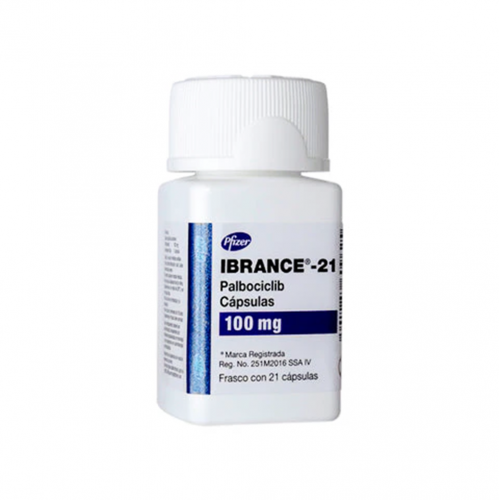
Ibrance 100 mg Capsule
- Current Price:
Rs. 14000
Price may vary by pharmacy and location.
- Generic Name (Formula)
Palbociclib
- Strength
- 100 mg
- Dosage Form
Capsule
- Manufacturer
- Pfizer
- Primary Use
- Breast Cancer Treatment
More Details About the Medicine
Ibrance 100 mg Capsule contains palbociclib 100 mg, a targeted anticancer medicine belonging to the CDK4/6 inhibitor class. It is used as part of combination treatment for certain forms of advanced or metastatic breast cancer.
Unlike many conventional chemotherapy medicines that broadly affect rapidly dividing cells, palbociclib targets cyclin-dependent kinases 4 and 6 (CDK4 and CDK6), proteins involved in controlling cell division.
The 100 mg strength is particularly important in treatment because it is the first recommended dose reduction from 125 mg when an oncologist decides that a lower palbociclib dose is needed because of adverse effects or tolerability.
Composition
Each Ibrance 100 mg hard capsule contains:
Palbociclib — 100 mg
Pfizer’s Pakistan product information also states that each 100 mg capsule contains 74 mg lactose (as monohydrate) as an excipient with known effect.
The 100 mg capsule has a light-orange body and caramel cap, with “PBC 100” and “Pfizer” printed on the capsule.
What Is Ibrance 100 mg Used For?
Ibrance is primarily used in the treatment of certain types of advanced or metastatic breast cancer.
Palbociclib is generally used with other anticancer/endocrine medicines rather than alone. The exact combination depends on factors such as hormone-receptor status, HER2 status, previous endocrine treatment, molecular characteristics and the patient’s overall treatment plan.
For example, established treatment regimens include palbociclib in combination with an aromatase inhibitor or fulvestrant in appropriate patients with hormone receptor-positive disease. Current prescribing information includes additional combinations for specific patient groups.
Ibrance should therefore be prescribed and monitored by an oncologist rather than used based simply on a breast-cancer diagnosis.
Why Might an Oncologist Prescribe the 100 mg Strength?
This is one of the most useful distinctions to explain on the 100 mg profile.
The usual recommended starting dose for Ibrance capsules is 125 mg once daily. When a dose reduction is necessary because of treatment-related toxicity, Pfizer’s recommended dose levels are:
| Treatment level | Ibrance dose |
|---|---|
| Recommended starting dose | 125 mg once daily |
| First dose reduction | 100 mg once daily |
| Second dose reduction | 75 mg once daily |
If a patient cannot tolerate 75 mg daily, discontinuation may be considered rather than reducing the dose further.
Therefore, receiving Ibrance 100 mg does not necessarily mean that treatment is less effective or that something has gone wrong. Dose modification is an established part of palbociclib treatment and is determined according to safety and tolerability.
Patients should never reduce from 125 mg to 100 mg themselves.
How Does Palbociclib Work?
Some breast cancer cells rely on signals involving CDK4 and CDK6 to progress through the cell cycle and continue dividing.
Palbociclib inhibits these kinases. This can prevent susceptible cancer cells from progressing normally through the cell cycle and thereby slow their proliferation.
This mechanism is why Ibrance is classified as a targeted kinase inhibitor or CDK4/6 inhibitor rather than conventional cytotoxic chemotherapy.
How Is Ibrance 100 mg Taken?
When 100 mg has been prescribed as the patient’s daily dose, the usual palbociclib cycle remains:
100 mg once daily for 21 consecutive days, followed by 7 days without Ibrance.
Together, these 28 days form one treatment cycle.
However, an oncologist may interrupt treatment, delay the next cycle or modify the schedule depending on blood counts and adverse effects.
The patient should follow the treatment calendar supplied by the oncology team rather than starting a new cycle independently.
Take Ibrance Capsules With Food
Ibrance capsules should be taken with food, preferably at approximately the same time each day.
Capsules should be swallowed whole.
Do not:
- Open the capsule
- Crush it
- Chew it
- Take a capsule that is cracked, broken or otherwise damaged
This instruction specifically concerns the capsule formulation. Patients should not assume that instructions for another Ibrance formulation are identical.
What If a Dose Is Missed?
If you forget a dose of Ibrance, do not take an additional capsule to replace it.
Take the next prescribed dose at the normal time.
The same principle applies if you vomit after taking a dose: another dose should not automatically be taken that day.
If there is uncertainty about the treatment calendar, contact the oncology team rather than adjusting the schedule yourself.
Blood Counts and Ibrance Treatment
One of the most important aspects of palbociclib treatment is monitoring blood-cell counts.
Ibrance can suppress bone-marrow activity, particularly affecting neutrophils, which are white blood cells involved in fighting infection.
Neutropenia is one of the most frequent adverse effects of Ibrance.
A complete blood count (CBC) is therefore monitored before and during treatment. Current Pfizer prescribing information calls for CBC monitoring before starting therapy, at the beginning of treatment cycles, at specified early-cycle intervals and when clinically indicated.
If neutrophils or other blood cells fall too low, the oncologist may temporarily interrupt Ibrance, delay another cycle or reduce the dose.
This is one of the circumstances in which a patient originally receiving 125 mg may subsequently be prescribed Ibrance 100 mg.
Side Effects of Ibrance 100 mg
Side effects vary between patients and also depend on the other medicines being used alongside palbociclib.
Important and commonly reported effects include:
- Low neutrophil count
- Reduced white blood cells
- Anemia
- Reduced platelet count
- Infections
- Fatigue
- Nausea
- Diarrhea
- Mouth sores or stomatitis
- Reduced appetite
- Hair thinning or hair loss
- Changes in liver enzymes
Blood-test abnormalities are an important part of the drug’s safety profile, which is why laboratory monitoring continues even when a patient feels well.
Medicines and Foods That Can Interact With Ibrance
Palbociclib is affected by the CYP3A enzyme system. Certain medicines can substantially increase or decrease the amount of palbociclib in the body.
Strong CYP3A inhibitors and strong CYP3A inducers can therefore cause clinically important interactions.
Patients should give their oncology team a complete list of:
- Prescription medicines
- Non-prescription medicines
- Vitamins
- Herbal products
- Supplements
Grapefruit and grapefruit products should be avoided during Ibrance treatment because they can interact with the medicine.
Ibrance 100 mg vs Ibrance 125 mg
Both strengths contain exactly the same active medicine—palbociclib—but the amount per capsule differs.
Ibrance 125 mg is the usual recommended starting dose.
Ibrance 100 mg is the established first dose-reduction level when a lower dose is required because of adverse reactions or tolerability.
A further reduction to 75 mg may be required in some patients.
The choice of strength should be made by the treating oncologist based on the patient’s treatment response, blood counts, adverse effects, interacting medicines and other clinical factors.
Explore More Medicines
Browse our Medicines A–Z directory to find information about other medicines, including their uses, strengths, side effects and precautions.
Need Medical Advice?
Find a qualified doctor on NamakMandi.pk to review your symptoms and treatment.
Medical Disclaimer
The content on NamakMandi.pk is written and reviewed for general information only. It does not replace a diagnosis, treatment plan, prescription, or advice from a qualified healthcare professional. Never delay seeking medical care because of something you have read here. In an emergency, contact your nearest hospital immediately.