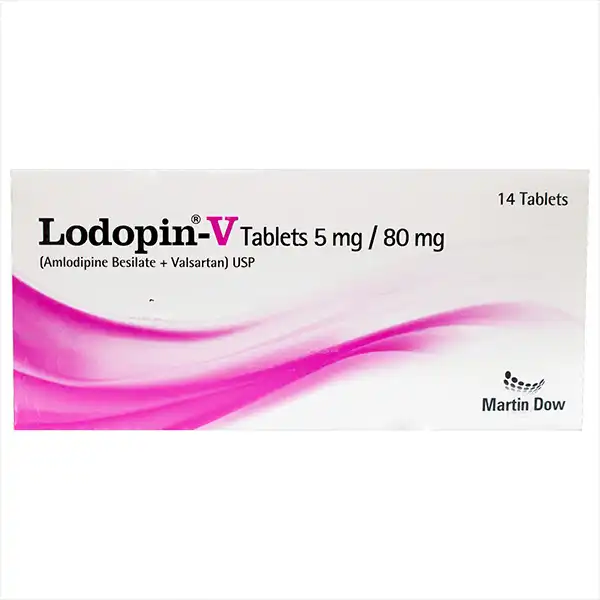
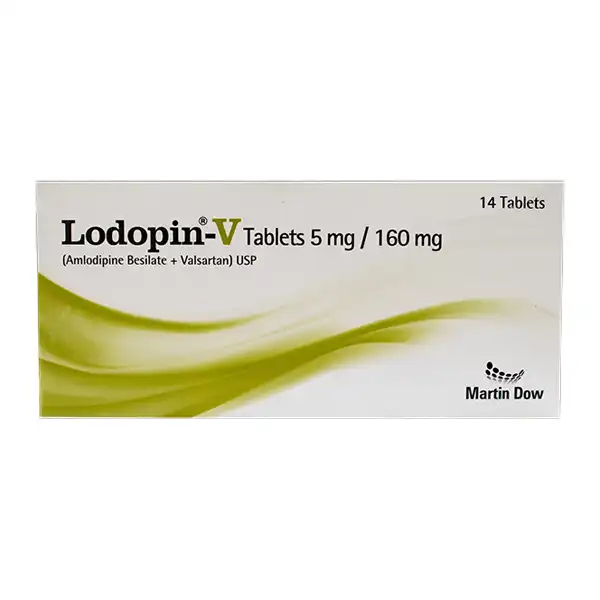
Lodopin-V 5/160 mg Tablet
- Current Price:
Rs. 490
Price may vary by pharmacy and location.
- Generic Name (Formula)
Amlodipine + Valsartan
- Strength
- 5/160 mg
- Dosage Form
Tablet
- Manufacturer
- Martin Dow
- Primary Use
- Hypertension
More Details About the Medicine
Lodopin-V 5/160 mg Tablet is a two-component medicine prescribed for the management of hypertension (high blood pressure). It combines amlodipine 5 mg with valsartan 160 mg, allowing two different blood-pressure control mechanisms to be delivered in a single daily tablet.
Compared with Lodopin-V 5/80 mg, this formulation keeps the amlodipine component at 5 mg while providing a higher 160 mg dose of valsartan. It may therefore be selected for patients who require greater blockade of the angiotensin II pathway as part of their hypertension treatment.
What Is Lodopin-V 5/160 mg Used For?
Lodopin-V 5/160 mg is used to achieve better control of persistently elevated blood pressure when treatment with a single agent is inadequate or when a combination regimen is considered appropriate.
It may be prescribed for patients who:
- Remain hypertensive despite treatment with one blood-pressure medicine
- Require both amlodipine and valsartan
- Have been taking these medicines separately and are suitable for a fixed-dose combination
- Need treatment adjustment from another amlodipine/valsartan strength
The aim is to maintain blood pressure within an individualized target range and thereby reduce the long-term cardiovascular burden associated with hypertension.
What Do the Numbers 5/160 Mean?
Lodopin-V contains two active medicines, so both strengths appear in the product name.
5 mg refers to amlodipine.
160 mg refers to valsartan.
They should not be added together or interpreted as a single 165 mg medicine. Each ingredient belongs to a different drug family and performs a different role.
A Dual Approach to Hypertension
Blood pressure is influenced by several physiological systems. Lodopin-V targets two of them simultaneously.
Amlodipine: reducing resistance in the arteries
Amlodipine is a dihydropyridine calcium channel blocker. By limiting calcium entry into vascular smooth-muscle cells, it reduces contraction of the arterial walls.
The arteries become less constricted, allowing blood to circulate with less resistance.
Valsartan: blocking angiotensin II
Valsartan is an angiotensin II receptor blocker (ARB).
Angiotensin II normally binds to AT1 receptors and promotes blood-vessel constriction, among other cardiovascular effects. Valsartan blocks these receptors and reduces the hormone’s influence on the circulation.
Using these mechanisms together can produce an additive blood-pressure-lowering effect.
Why Might 160 mg of Valsartan Be Prescribed?
The valsartan component of this formulation is twice that of Lodopin-V 5/80 mg.
A doctor may choose 5/160 mg when additional blood-pressure control is required while keeping amlodipine at 5 mg.
This can be clinically useful because simply increasing amlodipine is not always the preferred next step. Higher amlodipine exposure can increase certain dose-related adverse effects, particularly peripheral edema.
The choice between different combinations depends on the patient’s previous treatment and response rather than on one formulation being universally “better.”
How Is Lodopin-V 5/160 mg Taken?
The medicine is commonly prescribed once daily.
It can generally be taken with or without food. Choosing a convenient time and taking the tablet consistently each day can improve adherence.
Patients should:
- Use only the prescribed strength.
- Swallow the tablet with water.
- Maintain their normal dosing schedule unless advised otherwise.
- Avoid taking an extra tablet after an isolated high reading.
- Continue any recommended home blood-pressure monitoring.
The dose should be changed only by the treating healthcare professional.
What Side Effects Can Occur?
Since Lodopin-V contains two medicines, its adverse-effect profile reflects both components.
Possible effects include:
- Ankle or lower-leg swelling
- Dizziness
- Headache
- Fatigue
- Flushing
- Palpitations
- Nausea
- Abdominal discomfort
- Low blood pressure
Less commonly, clinically significant changes in kidney function or potassium may occur, particularly in susceptible patients.
Medicines That Need Extra Attention
Drug interactions are particularly relevant because Lodopin-V contains both a calcium channel blocker and an ARB.
Tell your doctor if you regularly use:
- Other antihypertensive medicines
- ACE inhibitors or additional ARBs
- Potassium supplements
- Potassium-sparing diuretics
- Lithium
- Diuretics
- NSAID painkillers
- Certain medicines affecting CYP3A4
- Potassium-containing salt substitutes
The combination may still be appropriate in some situations, but monitoring or treatment adjustments can be necessary.
Precautions
Lodopin-V requires additional consideration in people with:
- Kidney disease
- Significant liver impairment
- Hyperkalemia
- Severe dehydration
- Very low blood pressure
- Severe aortic stenosis
- Heart failure
- Renal artery stenosis
- Previous hypersensitivity to amlodipine or valsartan
Inform the prescribing doctor about all major medical conditions before treatment is started.
Explore More Medicines
Browse our Medicines A–Z directory to find information about other medicines, including their uses, strengths, side effects and precautions.
Need Medical Advice?
Find a qualified doctor on NamakMandi.pk to review your symptoms and treatment.
Medical Disclaimer
The content on NamakMandi.pk is written and reviewed for general information only. It does not replace a diagnosis, treatment plan, prescription, or advice from a qualified healthcare professional. Never delay seeking medical care because of something you have read here. In an emergency, contact your nearest hospital immediately.